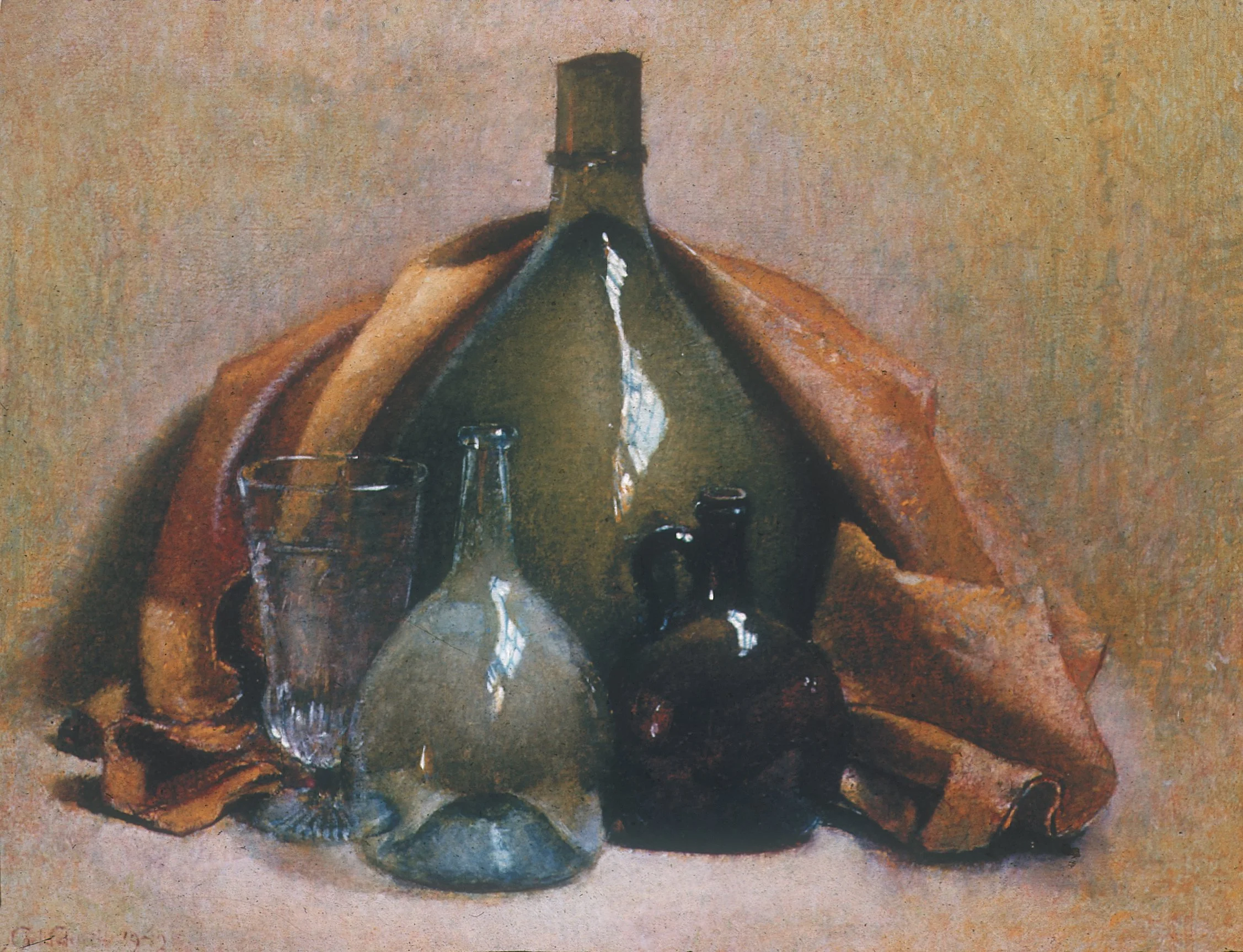
Like Leonardo da Vinci, Michelangelo, and Paul Cézanne, Carl Schmitt sought the underlying principles that make great art possible. Leonardo explored proportion and the hidden order of nature. Michelangelo sought to liberate form from matter. Cézanne revealed the geometric structure underlying appearances through the cylinder, sphere, and cone.
Schmitt pursued a different and more comprehensive question: What is the structure of beauty itself?
Through a lifetime of painting, Schmitt developed a uniquely triune vision of beauty rooted in the Christian understanding of the Trinity. He believed that reality itself reflects three fundamental divine actions: Creation, Sustenance, and Redemption. In art, these appear as three distinct but interconnected dimensions of beauty: the Lyric, the Epic, and the Dramatic.
The Lyric expresses beauty in its freshness, innocence, and wonder through rhythmic curves, flowing forms, and yellow-white light. The Epic carries those rhythms into space, shadow, proportion, and relationship through straight lines, squares, cubes, and blue light. The Dramatic perfects and transforms the earlier forms through diagonals, triangles, cones, red light, and a heightened sense of illumination and fulfillment.
Importantly, Schmitt did not regard these as stages that replace one another. Each possesses its own integrity and can stand alone as a complete expression of beauty. Together, however, they reveal beauty in its fullest dimensions.
Unlike many aesthetic theories, Schmitt's vision emerged directly from artistic practice. He embodied these principles in his paintings through a distinctive process of layering color, glazing, creating dark "voids," and delicately etching the paint surface with a sharpened penknife. His mature works sought to reveal what he called a perfected or substantive beauty.
Schmitt's unique contribution was therefore not merely a style of painting or a theory of art. He offered a comprehensive understanding of beauty that united artistic practice, philosophy, theology, human development, color, form, and technique into a single coherent vision. His central claim was that beauty possesses an intelligible, triune structure because reality itself reflects the creative, sustaining, and redemptive activity of the Holy Trinity.
In this way, Schmitt expanded the conversation from how artists create beautiful works to what beauty itself is.